좌석
Finding your seat at Gocheok Sky Dome: what the block number on your ticket means
고척스카이돔 좌석번호 — 한 방향으로 돌아갑니다
Four levels, one direction, and a single break in the loop. Three digits read correctly will walk you to your block from any entrance, without a map and without knowing which way is north.

Four levels, numbered outward from the floor. The two red dashed lines are the edges of the break where the seating stops and the numbering starts again — it widens with height, because the upper decks stop short of that corner. The red arrow is the direction every level counts in. Cyan circles are the seven gates, A to G; red squares are the ticket offices, which the chart marks 2, 3 and 4.
Schematic, drawn from the venue’s own chart rather than traced from it. Which block sits beside which gate to a single number is a question for that chart, linked at the foot of this page.
Scope 적용 범위
Covers how Gocheok Sky Dome numbers its permanent seating, read off the Seoul Facilities Corporation's own chart and facility pages: the four levels, which direction the numbers run, where the sequence breaks, and where the gates and ticket offices sit relative to it. The chart it is read from is drawn for baseball — it has dugouts on it. The bowl blocks are poured concrete and do not move, so a concert ticket naming block 304 means this 304; but which blocks are sold, what sits on the floor, which gate your ticket admits you through and when doors open are the promoter's, set per show, and nothing here replaces the chart on your own booking page. One venue. KSPO Dome and Inspire Arena number themselves differently and need their own pages.
Checked against official sources 출처 기준 확인
Every step below comes from the platform's own help pages, the official announcement for a show, or press reporting — each one linked at the bottom of this page with the date it was read. This is the official procedure as the platforms stated it on 2026-10-22.
It is not a first-hand account and does not claim to be: nobody on this site has created an account and gone through this flow personally. That is the difference between this page and a verified one, and it is why this page expires sooner — after 90 days it stops making the claim by itself rather than waiting for anyone to notice.
Check the official announcement for your specific show before acting on any step.
A seating chart is drawn for somebody who already knows how the building is organised. It is a flat picture of 123 numbers, and it answers the question you have at home — is this a good seat — rather than the question you have at 18:40 standing against a concrete wall with a number on it that is not yours.
That second question has a short answer, because the numbering is a system rather than a list. Four levels, one direction, one break. Learn those three things and you stop needing the chart.
Step by step
단계별 절차
ㄱ Step 01
Decide first whether your seat is in the building or on the floor
2 minutesThree digits between 101 and 435 mean a permanent block in the bowl, and the rest of this page locates it. Anything else — a letter on its own, FLOOR, 플로어, a standing zone, a table or box name — is on the field, which has no permanent seats at all. The field is bare floor that the promoter covers, divides and names for each show, so only that show's own chart places it.
Where this breaks
Matching a letter on your ticket to a letter on the venue's chart. There are three different alphabets on this one building: the seven gates are lettered A to G, the chart prints field-level baseball zones in T, S and D series, and a concert's floor blocks are lettered by the promoter. A letter is only meaningful next to the thing that issued it.
ㄴ Step 02
The first digit is the level, and there are four of them
1 minute101 to 132 is the lowest ring, closest to the floor. 201 to 222 is a short second tier. 301 to 334 is the third. 401 to 435 is the top. That matches the building the venue describes — four storeys above ground over two basement levels — so the hundreds digit is a floor number, not a zone name. A 4 is as high as the building goes.
Where this breaks
Expecting the 200 level to behave like the others. It is the shortest, 22 blocks against 32, 34 and 35, and it is the only one with holes in the middle of it: the chart shows stretches along the far side of the building carrying no 200-level seating at all. Consecutive numbers there are not necessarily neighbours on the ground.
ㄷ Step 03
The other two digits are a position on a loop that turns one way
2 minutesInside a level the numbers run in a single direction all the way round, and that is the venue's own word for it rather than something measured off the picture: the description published with the chart says the blocks run 시계방향 — clockwise — starting from the bottom right of the infield side, and then lists them in that order. Every level starts from the same side of the building. So the step from 401 to 405 is the same rotation as the step from 301 to 305, in the same direction, at a different height. There is no left half and right half to learn, and no odd and even side.
Where this breaks
Expecting the levels to stack block for block. They hold 32, 22, 34 and 35 blocks, so they drift apart as they go round: only the line they start from is shared. 417 is not above 317, and a friend in 210 is not below you in 310.
ㄹ Step 04
The loop has exactly one break, and there is no gate in it
3 minutesThe seating does not close into a full circle. On the side the chart draws at the right there is a wedge of building with no seats at any level, and that is where the numbering restarts — 132 and 101 face each other across it, and so do 435 and 401. That break is not one width: measured off the chart it is about 44 degrees at the 100 level, 71 at the 200, 91 at the 300 and 96 at the 400, because the upper decks stop short of that corner while the lowest ring nearly closes around it. The seating is a horseshoe that opens as it rises. The seven gates run clockwise in the same direction the numbers do: A, B, C, D and E along the near side, then F and G across the far one. A is the first gate after the break; G is the last one before it. Gate letters and block numbers are one scale, which is the whole reason the building can be navigated without a compass.
Where this breaks
Assuming a gate you can see is a gate you may use. The venue's own chart marks gate C, the one at the centre, as an entrance reserved for R.d-club and skybox season-ticket holders rather than a general one. The nearest door is not always yours.
ㅁ Step 05
Arrive on a side you can work with
5 minutes, before the dayGuil Station on Line 1, exit 2, is about 150 metres and three minutes from the venue, and on a concert night the operator publishes advice to get off a stop earlier — Guro if you boarded from Seoul or the Suwon and Anyang direction, Gaebong if you came from Incheon or Bucheon. Which you take changes which part of the perimeter you reach first, and therefore how far round you walk. It does not change the rule in the next step, which works from any entrance.
Where this breaks
Planning the walk to the building and not the walk around it. Twenty-five thousand people arrive at a ring roughly 600 metres round, and the last two hundred of your metres are the ones with a crowd in them.
Gocheok Sky DomeThe stations, the exits, and why the nearest is not the right one
ㅂ Step 06
At the wall, read two block numbers and you know which way to walk
5 minutes on the nightYou do not need to know which compass direction the chart's top points to, and the venue does not publish it. You need two numbers in a row. Read a block number where you are standing, walk a few metres, read the next one. Now you know which way the sequence rises. If yours is higher, keep going; if lower, turn round. Because the loop turns one way at every level, the answer you get on the outside of the building is still true on the stairs and still true on the concourse.
Where this breaks
Steering by the floor instead of by the signs. A dome has no view out of it and every stretch of concourse looks like every other stretch; the block numbers are the only thing in the building that tells you where you are. The one place the two-number rule fails is the break, and the break announces itself, because the numbers stop.
ㅅ Step 07
Know which half of this the promoter decides
5 minutesThe building fixes the block numbers, the four levels, the gate letters and the ticket offices — the chart marks three, numbered 2, 3 and 4, with the infield one beside gate E and the two outfield ones flanking gates F and G. The promoter fixes everything that changes per show: which blocks are sold at all, because a stage against one end of the floor kills the blocks behind it; what the floor sections are called; which gate your ticket admits you through; and when the doors open. Where your ticket and this page disagree, your ticket is right.
Where this breaks
Treating the venue's chart as your show's chart. It is drawn for baseball and has dugouts on it. It is the authority on where 304 is and on nothing else about your night.
The chart itself
좌석배치도
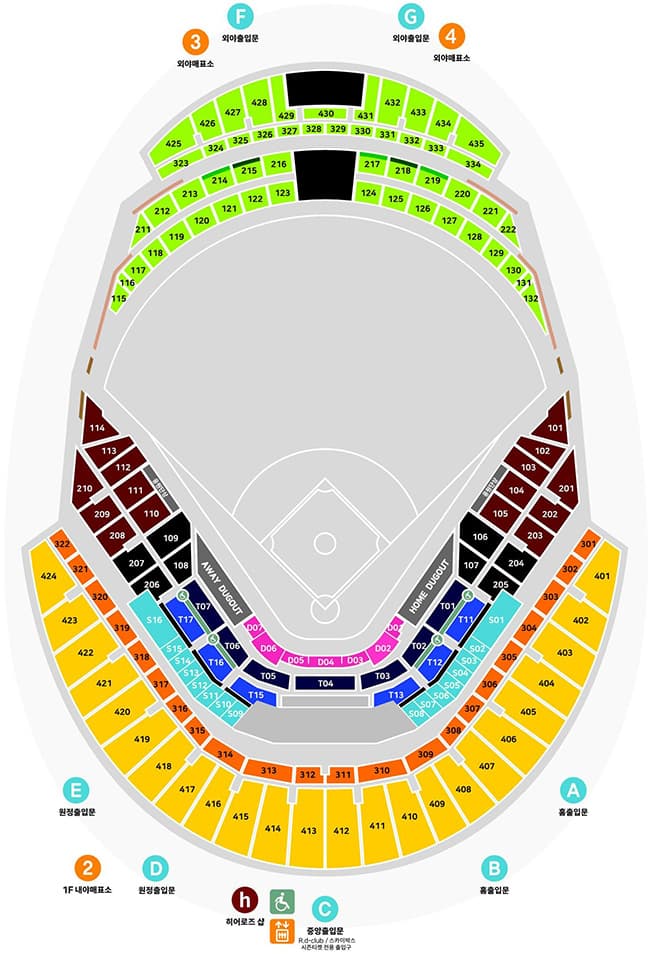
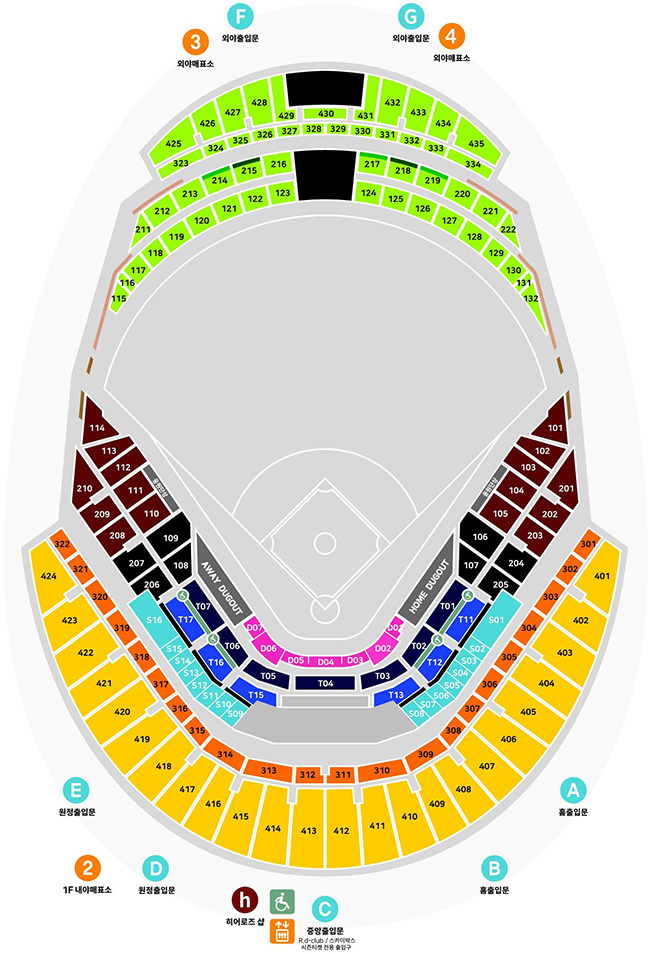
The chart this page is read from. It is drawn for baseball — the dugouts are on it — and it is the authority on where a numbered block is, not on what is sold for your show.
- Source
- 서울시설공단 (Seoul Facilities Corporation) — the page it is published on
- This copy
- Taken 2026-10-22. The file as it was taken, and the operator’s own copy to check it against.

Questions people ask
자주 나오는 질문
What does a block number like 304 actually tell me?
Two things. The 3 is the level — the third of four, counting the lowest ring as 1. The 04 is a position on a loop that runs one direction all the way round that level, starting from a fixed side of the building. So 304 is low-numbered, which puts it near where the numbering begins, a short walk clockwise from the break in the seating.
Which direction do the numbers run?
Clockwise, and the venue says so itself: the description published with its chart reads 시계방향, starting from the bottom right of the infield side, and the block ranges it then lists match the picture on both sides. The same direction at every level. The gate letters run the same way: A, B, C, D, E along the near side and F, G across the far side. That means letters and numbers rise together — if you pass gate D on your way to gate E, your block numbers are rising too.
Is block 417 directly above block 317?
No. The levels hold different numbers of blocks — 32, 22, 34 and 35 from the bottom up — so they share only the line their numbering starts from and drift apart from there. Use the level you are actually on to navigate, not the one your friend is on.
Why do the numbers stop and start again?
Because the seating is a horseshoe, not a ring. There is a wedge of the building with no seats in it at any level, and the numbering restarts there: 132 faces 101 across it, 435 faces 401. It is also the one stretch of the perimeter with no gate in it, which makes it easy to recognise. It is wider the higher you are — about 44 degrees of the circle at the 100 level against 96 at the 400 — so on the top level more of the ring is missing and walking the long way round costs more.
Can I go in through whichever gate is closest?
Not necessarily. Gate access is set per event by the promoter and printed on your ticket, and at least one gate is not general even on an ordinary day — the venue's chart marks the centre gate as an entrance for R.d-club and skybox season-ticket holders. Read your ticket, then find that gate.
The chart on the venue site looks like a baseball stadium. Is it the right one?
It is the right chart for the question this page answers and the wrong one for most others. It is drawn for baseball, dugouts included, and the venue seats 16,601 for a match against about 25,000 for a concert — so a concert is a different arrangement of the same building. What does not change is the concrete: the numbered blocks are permanent, so the chart tells you where 304 is. It cannot tell you whether 304 is sold for your show, or what is on the floor.
Sources 출처 · last checked 2026-10-22
- 01서울시설공단 고척스카이돔 — 좌석배치도: the seating chart, and the text description published with it, which states the clockwise direction and lists every block range on each side
- 02서울시설공단 고척스카이돔 — 시설안내: four storeys above ground over two basement levels, and 16,601 seats
- 03서울시설공단 고척스카이돔 — 이용안내: the 25,000 cultural-event capacity the concert configuration is drawn against
- 04서울시설공단 고척스카이돔 — 찾아오시는길: the stations, exits and walking distances
If one of these has moved on since, the official announcement for your show is the authority — not this page.
Walked this? 제보
Nobody has reported walking this one yet. This page is traced to the platform's own documentation and no further — if you have just done it, what the screens actually said is the thing that would improve it most.